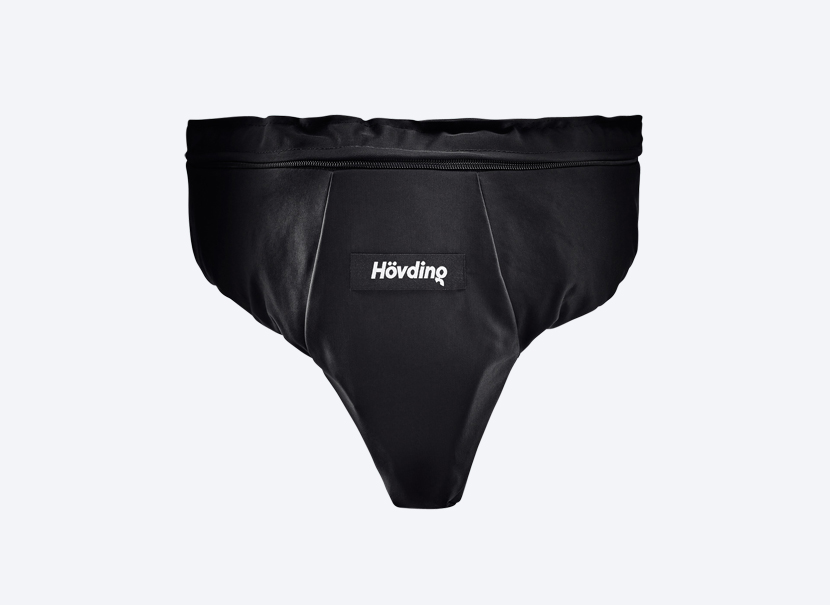
Hövding is the world's first airbag for cyclists and is the result of
intensive research since 2005. Through advanced sensors, Hövding can
sense the cyclist's movement patterns and will react in case of an
accident. The unique airbag will then inflate, fixate your neck and
provide the world's best shock absorption.
Hövding is the world's first airbag bicycle helmet, invented by
Anna Haupt and Terese Alstin in Malmö, Sweden in 2005. After seven years
of research, development and testing, the Hövding was launched in
November 2011. The two founders Anna Haupt and Terese Alstin left the
company in beginning of 2015 when the new external CEO didn't agree on
the company visions.
Hövding was initially created as a master thesis for the founders' Master of Industrial Design at the Faculty of Engineering at Lund University in Sweden. Their studies included the comparison of accelerometer data from bicycle crashes against 'typical' cycling.The Hövding contains accelerometers that detect these unusual movements
which then deploys the airbag if the movement patterns match the
profile of a crash. Each Hövding airbag also contains a "Black Box" that records the accelerometer data 10 seconds before a deployment.
This data can be used by the Hövding developers to improve the product.
The Hövding collar is constructed of a waterproof material, and has
interchangeable fabric "shells" that allow colour customisation. Hövding is CE certified
after undergoing an extensive process for approval by SP Technical
Research Institute of Sweden. CE marking is required for a cycle helmet
to be able to be sold in Europe and certifies that the helmet complies
with the requirements laid down in the EU Directive for personal
protection equipment.
In March 2015 Hövding 2.0 was released. There are a number of changes
that were added based on feedback from users. These include
improvements to the weight, comfort and change in location of the USB
port.
Safety tests
In 2012 the Swedish insurance company Folksam
tested 13 cycle helmets on the market. They carried out an impact test
on the same principles as for CE marking but with a higher impact speed,
25 km/h instead of 20 km/h.
All the traditional helmets achieved G-force ranging from 196 to 294
g. The lower the value, the better the helmet’s ability to protect the
cyclist’s head in an accident. Hövding achieved 65 g, providing at least
three times better shock absorption than the other helmets. A test by French Que Choisir concluded that Hövding did not meet international safety requirements, according to the magazine of the Swedish Consumers' Association.




No comments:
Post a Comment