

"We find that the detected signals have exactly the shape of an ETI [extraterrestrial intelligence] signal predicted in the previous publication and are therefore in agreement with this hypothesis," the duo wrote in the paper, which was published online Oct. 14 in the journal Publications of the Astronomical Society of the Pacific.
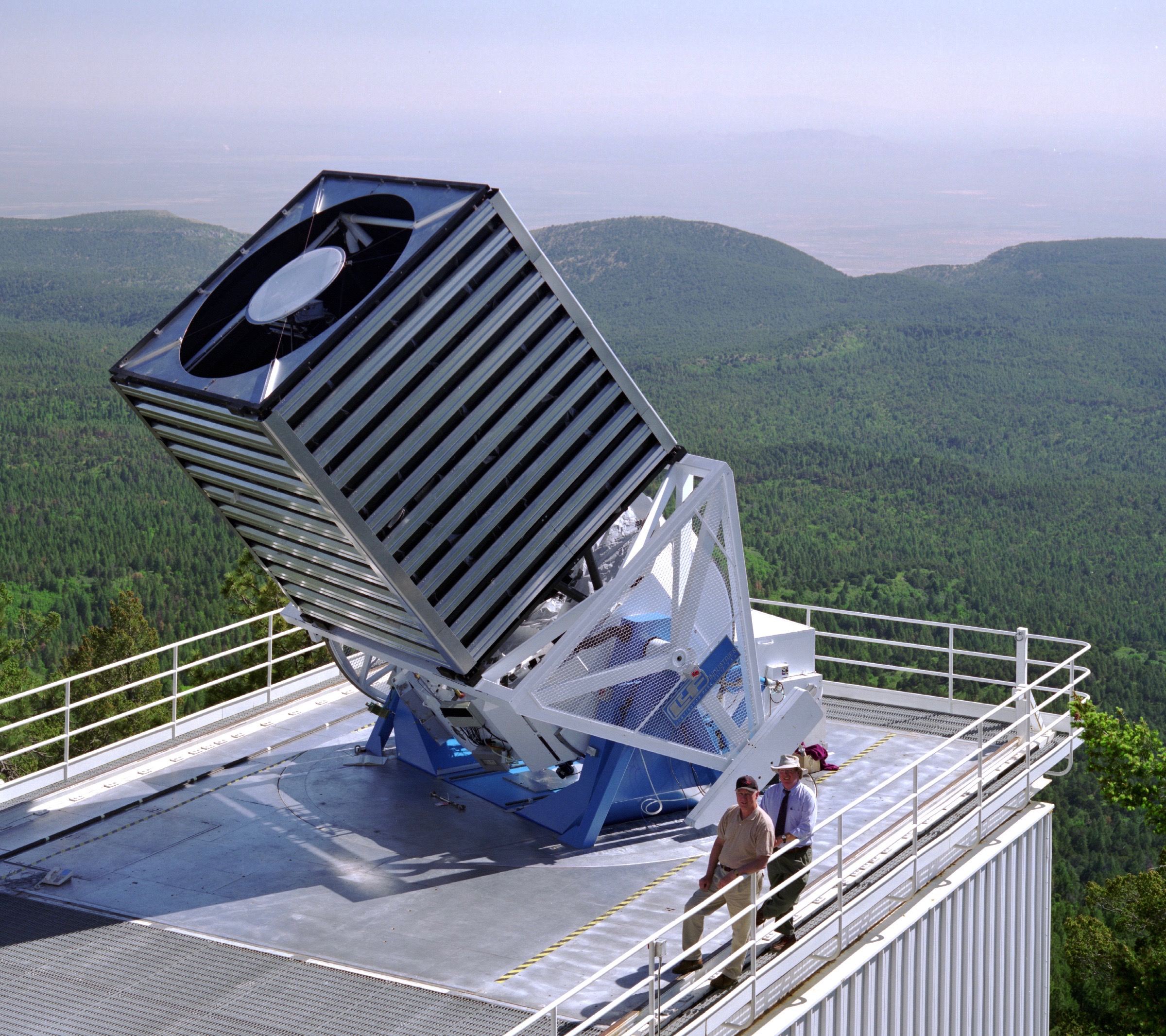
"The fact that they are only found in a very small fraction of stars within a narrow spectral range centered near the spectral type of the sun is also in agreement with the ETI hypothesis," the researchers added in the study. (Borra and Trottier looked at the spectra of 2.5 million stars studied by the Sloan Digital Sky Survey, which uses a telescope in New Mexico.)
But don't get too excited: Borra and Trottier said that additional observations are needed to confirm this hypothesis, and outside astronomers are even more emphatic on this point. Indeed, a healthy dose of skepticism is warranted, said Seth Shostak, a senior astronomer at the SETI (Search for Extraterrestrial Intelligence) Institute in Mountain View, California.
For example, it seems unlikely that 234 separate alien societies would be sending out such similar signals more or less simultaneously, Shostak said.
"It would be like expecting us to send the same signals as the Abyssinians — it doesn't make a whole lot of sense," he told Space.com. "If I were a betting guy, I'd bet this is an artifact of the way they processed their data."
Shostak also said that he knew of six different reviewers who had recommended against publishing the paper, at least without significant revision. However, he did stress that Publications of the Astronomical Society of the Pacific is a reputable journal.
The astronomers behind Breakthrough Listen, a $100 million project that's scanning the heavens for SETI signals over the next 10 years, also urged skepticism.
"The international SETI community has established a 0-to-10 scale for quantifying detections of phenomena that may indicate the existence of advanced life beyond the Earth called the 'Rio Scale,'" team members of Breakthrough Listen, whose science program is headquartered at the Berkeley SETI Research Center (BSRC) at the University of California, Berkeley, said in a statement. "The BSRC team assesses the Borra-Trottier result to currently be a 0 or 1 (None/Insignificant) on this scale."
But skepticism is not the same thing as dismissal. Shostak thinks the stars singled out by Borra and Trottier are worthy of follow-up investigation, as does Breakthrough Listen. Indeed, the latter organization plans to study several of these stars using the 7.9-foot (2.4 meters) Automated Planet Finder optical telescope at Lick Observatory in California, team members said in the same statement.
The long history of SETI false alarms — including a detection that generated buzz this past August, but was soon traced to a Russian satellite — shouldn't deter scientists from checking out intriguing candidates, Shostak stressed.
"You can't get too cynical," he said. "You don't want to throw the baby out with the bathwater."
SOURCE:
Space.com
No comments:
Post a Comment